Showing posts with label Mental Health. Show all posts

Wednesday, 6 July 2016

Hari Raya Aidilfitri - Maaf Zahir dan Batin

The celebration of Hari Raya Aidilfitri marks the end of the Ramadan month. It is a holiday that symbolizes the completion of the fasting period, and is celebrated on the first day of the Islamic month of Syawal.

Hari Raya celebration is also the time to ask for forgiveness and to forgive others. It is the time for reconciliation and renewal of relationships with others. Hence, the greeting “maaf zahir dan batin” is usually used during this celebration to mean “I seek forgiveness (from you) for my physical and emotional (wrongdoings)”.

Apologizing is indeed one of the most common method for reconciling with others after conflicts that are either large or small. Apology is shown by studies to foster happiness, promotes forgiveness, and restore balance to a relationship when it is done well.

So, what constitutes a good and effective apology?

Aaron Lazare, an apology expert, provides guidelines and criteria for an effective apology. He described that there are up to four parts to the structure of an effective apology, and they are: acknowledgement of the offense; explanation; expressions of remorse, shame, and humility; and reparation.


  • Acknowledgement of the offense – To acknowledge the offense that has been made by the offender. The acknowledgement of the offense made has to be clear in regards to the specificity of the offense, instead of being vague (“for whatever I did”); passive (“mistakes were made”); or conditional (“if mistakes have been made”). Use the empathic “sorry”. 
  • Explanation – Explain on how the offense is unacceptable, and show that it is unlikely to recur. A counterproductive explanation is such as when it is self-serving, defensive, or shallow. 
  • Expression of remorse, shame, and humility – These attitudes and emotions show that the offender recognizes the suffering of the offended as the result of the offense that has been done, and it helps assure that the offense will never recur. 
  • Reparation – To provide compensation to the damage done. The damage may be tangible or intangible, therefore compensation can be in real or symbolic way. Example of reparation for offense that causes damage or loss of tangible object would be replacement or restoration of the object. But when damage is intangible – ranging from insult to humiliation and death of loved ones – reparation would be in a form of gift, an honor, financial exchange, or acceptance of a tangible punishment from the guilty party. 

Effective apology heals oneself, the offended, and the relationship between the two, and it generates forgiveness and reconciliation.  Let’s renew our relationships with our family and friends in this festive season by practicing apology and forgiveness.

Thursday, 22 October 2015

How to talk to others about their Mental Health?

Are you concerned about someone's wellbeing and wished that you knew what to do? Here's a snippet of what you could say, or ask: 

Adapted from http://www.mentalhealth.gov/talk/friends-family-members/


Content: Low Yee Min, Master of Counseling, HELP University. 

Wednesday, 21 October 2015

How to help loved ones with Mental Health Concerns?


Talking to them provides the opportunity to share information, support, and guidance  resulting in:
• Early identification of possible mental health issues
• Early intervention
• Better understanding and compassion for the individual

When a friend or family member is showing signs of a mental health problem or reaching out to you for help, offer support by:
• Finding out if the person is receiving sufficient care—if not, connect him or her with help
• Expressing your concerns and support
• Reminding the person that help is available
• Asking questions, listening, and being responsive when mental health concerns arise
• Reassuring the person that you care about him or her
• Offering to help him or her with daily tasks
• Including friends and family members in your plans
• Educating others to better understand mental health concerns in light of providing more support
• Treating individuals with mental health concerns with respect, compassion, and empathy


Read more: http://www.namiyolo.org/tipsforfamilies.html


Content: Low Yee Min, Master of Counseling, HELP University. 

Monday, 5 October 2015

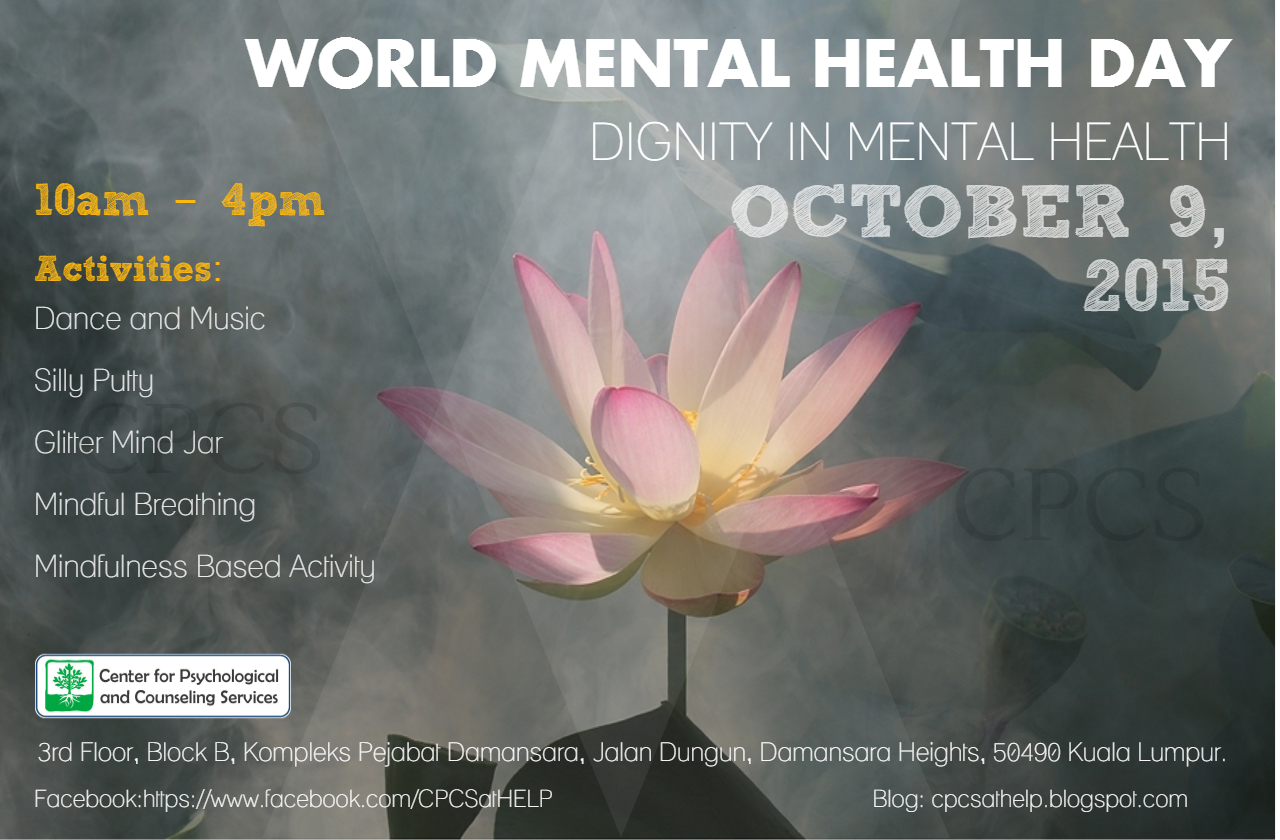
Dignity in Mental Health

Our Theme:
“Dignity in Mental Health” is the theme for this year’s event. Our focus is to promote awareness on the right to receive correct information related to mental health, as well as learning healthy coping habits to buffer against stressful situations.

Our Logo:
The lotus has been the subject of literary pieces in various cultures, owing to its clean appearance despite growing from a muddy environment. Zhou Dunyi, a famous Confucian poet once described the purity and elegance of the lotus in his writings, “I love only the lotus, for rising from the mud yet remaining unstained…”


Like the lotus, we aim to provide accurate, clear, and concise information related to mental health during the event. Therefore, we hope that our guests would gain helpful resources during their visit. 


Thursday, 10 September 2015

Mood Diary

Have you ever wanted to express your feelings but found it difficult to say it out aloud?
Some use art to reflect their emotions. We've come up with a neat little activity that you could try; a personalized mood tracker that you can use anytime anywhere.Simply draw on the blank face with colors or just a pencil. Note down any event(s) that brought about some emotions, whether pleasant or unpleasant. Finally, jot down some things that you do to make yourself feel better. Happy Expressing!
Try one of our templates below:


Friend or Therapist?

Ever wondered what goes on while speaking to a friend or therapist? We've prepared a simple list for your reference:


Unmask Yourself

Today we’re talking about the ‘masks’ that we wear regularly – care to set it down once in a while?


Wednesday, 9 September 2015

Who is at Risk?

A quick glance at some risk factors for those who are more vulnerable to attempting suicide:


Understanding Suicide

Wondering what is the difference between an attempt and an act? Here’s a quick guide:


World Suicide Prevention Day 2015

In conjunction with World Suicide Prevention Day 2015 which falls on 10th September, we are speaking up to increase awareness on talking about suicide and suicide prevention.

For the next two days, we will be posting up information on ways we can all be more aware of building resilience as well as how we can help support people we know who’ve been touched by suicide.

So please keep an eye out for updates at 9am, 12 noon and 3pm. Hope you find it useful reading!


Friday, 14 August 2015

Social Media in Moderation

Today we’re talking about how to best go about using social media in moderation. We’ve come up with a list of Dos and Don’ts to help you get started - check it out:


      How do we navigate this added element technology has introduced into our lives? It seems like nearly every task that we need to do in our daily lives with work, studies and even leisure is intertwined with the Internet, and more specifically, social media. Therefore it does not mean that we should completely say ‘no’ to social media, but can we moderate the amount we deal with daily?
      
       Let’s time ourselves – say 10 minutes in the morning before we start a task, we check into our various accounts to see updates and how others have fared in the last 24 hours or so. Inculcating a sense of ‘controlled’ checking of our social media can lead to a satisfaction; which would then spur us on to our other tasks rooted in reality.
       
      Allowing ourselves to pause and reflect is important too.  A good question to ask is ‘Do I “need” to check my Instagram?’ or “Do I ‘want’ to check my Instagram?’ Basic needs include food, air, water, shelter – these are conditions we need to survive. However, browsing through social media is a desire, which is a ‘want’. Identifying our impulses can instill a sense of control – as we can also choose to say ‘No, I don’t think I ‘want’ to do this now’.
      
      An additional factor to allow moderation is incentives – let’s reward good behavior! If we condition ourselves and say ‘No social media for the next 2 hours’ and accomplish it, let’s reward ourselves. Perhaps with a cup of coffee, or a cookie. Rewarding ourselves with small but meaningful things can strengthen our motivation.

      The next time we are tempted to post something, let’s pause and reflect if we really would like all our friends or followers to see what we’re about to post. Adding in that extra step may cause us to re-consider. Also, are we confusing the role of social media? Some of us may consider posting pictures as the same as ‘keeping’ them safe in a folder; however there is the added angle of many, many others who are privy to the same pictures as well.

      Countless hours of ‘connecting’ with others with a word, smiley face or other emoticons can ironically cause a sense of isolation and disconnect. So don’t forget whilst social media is a convenient tool to stay in touch, it is by no means the only way. So leave that chair, turn off your device, and interact with people in the real world – let’s connect in the real world.

In things a moderation keep; Kings ought to shear, not skin, their sheep.

Thursday, 13 August 2015

Mindful Drinking


While taking your “time-out” from the social media, try this relaxation exercise known as: Mindful Drinking


Relaxation exercises help:
1. To put your mind in a calm state after staring at your computer or phone for too long
2. To reduce unnecessary stress due to information overload
3. To be refreshed and focus better in completing your tasks

If you find this clip useful, feel free to try out other similar clips based on the link below to assist you in your relaxation exercises.  Have fun practicing!

Click on image to access: MINDFUL-Gym


 MINDFUL-Gym


Benefits of Being Mindful

How does being mindful of the present moment help us navigate through our usage of social media? Read below to understand the benefits:


Tuesday, 11 August 2015

Social Media Overdependency - Signs

On Day-2 of our week long awareness project, we’re talking about becoming overly dependent on social media – do you know the signs?

Watch our slid-eo (slide show-video) to find out more:


Monday, 15 June 2015

How are YOU Today?

How are you today? One of the most common greetings we hear, maybe more than once everyday. 

In view of raising the bar for people's awareness of themselves (self-awareness) and importance of the "little things" in our lives (mindfulness), we have a 2-day experiential exhibition catered to students and staff of our university for personal growth and perhaps may come in handy to help a friend in need.

On these two dates stipulated below, we will be at WISMA HELP and WISMA ELM for 5 hours (10am-3pm) with exciting activities just for you. 

So, How are you today?


Thursday, 21 May 2015

Self Compassion

We are often plagued by "bugs" that may appear in all areas of our lives, these "bugs" may be stress, anger, frustration, procrastination, distraction, self-blame, self-hate, or overall dissatisfaction in life.

Now, there is a "remedy" to exterminate these "bugs", and this remedy in mindfulness practice is self-compassion. When we feel compassion for others, we feel kindness towards them, and a desire to help reduce their pain. It is the same when you are compassionate towards yourself. Self-compassion in essence, creates a caring space within you that is non-judgmental - a space that allows you to accept your hurt, fear, or feelings of inadequacy as a part of being human, and allow those experiences with kindness and care. (Source: http://www.scoop.it/t/social-culture/?tag=self+compassion)


Self-compassion is the practice of repeatedly evoking good will toward ourselves especially when we are in pain, practice self-compassion today with these the activity below:


Wednesday, 20 May 2015

S.O.S

"One minute of day spent in stillness can change your life" - Gabrielle Bernstein

If you can spare a mere 5 minutes amidst your hectic lifestyle to practice Mindful S.O.S, you would be surprised at what 5 minutes of calmness can do. Mindful S.O.S creates a space in the day to stop, focus in the present moment, and connect with your breath and 5 senses. Incorporate Mindful Breathing and Mindful Sensing to practice Mindful S.O.S in these simple steps below:

Stop:               Stop whatever you are doing now, and get into a comfortable position
Observe:    Observe any thoughts and feelings that happen during the course of this breathing                                 exercise
Sense:          Notice the sensations that are happening inside (e.g. muscles tensing and relaxing)                               and around your body (i.e. sounds / smells / touch)

To further demonstrate how this exercise is done for maximum relaxation, you may follow the script below:
  1. Stop whatever you are doing now, and get into a comfortable position. You may choose to lower your gaze or close your eyes.
  2. Focus your attention to your breathing. Breathe in and out deeply and slowly. Breathe In. (Count) 1..2..3..4.. Hold. Breathe Out (Count) 1..2..3..4.. Repeat this exercise another two times.
  3. While continuing with your breathing, slowly move your attention to the sensations in your body.
  4. Feel the sensations on your face, on your cheeks, the cool air entering your nose and the warm breath that comes out of your mouth.
  5. Observe the sounds/smells/temperature in the environment.
  6. Feel the sensations in your neck, your upper back, your shoulders.
  7. Breathe in (Count) 1..2..3..4.. Breathe out (Count) 1..2..3..4..  Feel the sensations in your arms, your hands, your fingers.
  8. Feel the gentle beating of your heart, the movements of your chest as you breathe in and out.
  9. If you notice any thoughts or feelings happening, observe them and gently let them go.
  10. Feel the sensations in your lower back, in your stomach, in your thighs, your calves, your feet. Breathe in (Count) 1..2..3..4.. Hold. Breathe out (Count) 1..2..3..4..
  11. Continue breathing deeply and slowly. Tell yourself, “I am still now. Everything is going to be alright."
  12. Slowly turn your attention back to the space / room that you are in, back to the chair/space that you are sitting on.
  13. And whenever you are ready, you may slowly open your eyes.
  14. Give yourself one or two moments to compose yourself before going back to whatever it is you were doing.
  15. Practice as often as necessary.